


By 4 PM on May 30, some teams were still arguing. Not because anything had gone wrong. Because they had too many ideas.
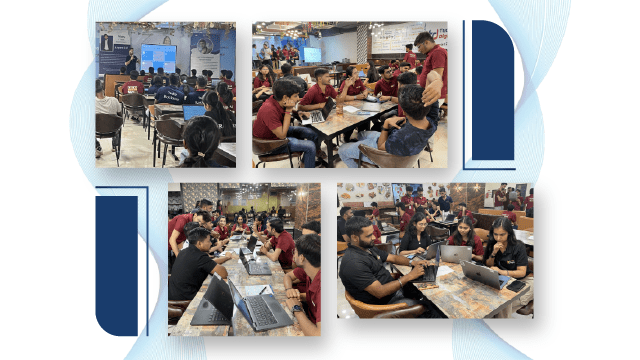
A few hours earlier, the AI Hackathon had begun at the Tudip Pune office as part of May’s Kaizen Day activities. More than 120 employees had formed 39 teams and spread out across meeting rooms, workspaces, and every available corner they could find.
By the afternoon, whiteboards were full of diagrams, arrows, sticky notes, and half-erased ideas. Some teams had already started shaping their final presentations. Others were still debating what problem they wanted to solve, and honestly, that was one of the best things about the day.
Nobody was rushing to build something just because it involved AI. People were trying to solve problems they genuinely cared about.
Thirty-Nine Teams. Thirty-Nine Different Conversations.
One of the interesting things about walking around the office that afternoon was seeing how differently every team approached the challenge.
At one table, a group was discussing software testing. A few desks away, another team was talking about learning experiences. Somewhere else, a discussion about project meetings had turned into a conversation about organizational memory and knowledge management.
Teams like Cleerly, SolveCube, Uniquily, Boomcloud, Teladoc Core, BrickPrism, AI Mavericks, Team ENGAGE, VoXlearn, GreenMinds, FiboAI Innovation, ByteBrains, Tudip Titans and many others all arrived with different perspectives.
Yet almost every conversation eventually came back to the same thing. People were not asking: “How do we use AI?” They were asking: “What is frustrating people today, and can AI help make it better?”
That small difference changed the entire tone of the hackathon.
Curiosity Before Technology
At one point during the event, Abhishek Vijay shared a thought that seemed to capture what everyone was experiencing.
“Hackathons turn curiosity into creation.”
The quote stayed with people because it reflected exactly what was happening. Most teams did not begin the day with a finished solution. Many began with a question.
- What if testing didn’t require so much maintenance?
- What if important meeting decisions never got lost?
- What if learning platforms could identify confusion before learners dropped off?
Those questions gradually became ideas. The ideas became discussions, and the discussions became working concepts.
Why People Signed Up
The hackathon wasn’t mandatory. People joined because they wanted to.
One participant explained it this way:
“I joined the hackathon to explore practical AI solutions, collaborate with colleagues, and learn through hands-on innovation. It was an exciting opportunity to turn ideas into something meaningful.”
— Manikarnika Ganpate
That sense of ownership was visible throughout the afternoon. Nobody needed encouragement to participate. The challenge was often getting teams to stop discussing new possibilities and focus on submitting their final ideas.
One Whiteboard Explained the Testing Problem Better Than Any Slide
Among the many projects presented, one focused on LEIP. The discussion started with testing. But it quickly became a conversation about complexity.
LEIP supports assessments, surveys, coaching experiences, learning journeys, community engagement programs, and leadership insights. Different organizations use the platform differently. Permissions vary. Workflows vary. Configurations vary.
At one point, the team’s whiteboard looked more like a city map than a software diagram. Arrows connected everything. Boxes pointed in every direction. Someone joked that the diagram needed its own user manual. The joke wasn’t entirely wrong.
The team was trying to show something many growing platforms experience. Testing becomes harder as products become more capable.
The discussion explored whether AI could help identify risk areas, recommend testing priorities, and reduce repetitive effort without removing the human judgment that quality assurance depends on.
Rather than replacing QA teams, the idea focused on helping them spend more time solving problems and less time maintaining processes.
Meetings Speak Volumes, Hidden Knowledge Shouldn’t
Another team focused on a challenge that felt instantly familiar: meetings.
Every organization has them. Every project depends on them, and yet everyone has experienced the same situation. A decision gets made. A task gets assigned. A few weeks later somebody asks, “When did we decide that?”
The answer exists somewhere. Usually, the challenge is finding it.
Using ideas inspired by Voxgent.ai, the team explored what an AI-powered meeting intelligence platform could look like.
Instead of simply recording conversations, the platform would understand them. Decisions could be captured. Action items could be tracked. Context could follow a project from one discussion to the next.
Several people stopped by to listen to the discussion because it addressed a problem almost everyone has experienced.
Looking at Learning From the Learner’s Side
Another project focused on learning experiences.
Soven Mishra explained the team’s motivation:
“The hackathon provided a platform to innovate, collaborate across teams, and explore how products like VoXgent can identify learning gaps, confusing content, and unclear instructions, helping create value for both curriculum teams and learners.”
— Soven Mishra
What made the idea interesting was its simplicity. Most learning platforms can tell you whether someone completed a course. They rarely explain where people struggled.
The team explored how AI could identify those moments and help curriculum teams improve content before learners become frustrated.
It was a practical problem, and practical problems often generated the most discussion throughout the day.
The Submissions Ended. The Conversations Didn’t.
Officially, idea submissions wrapped up at 4:30 PM. Unofficially, people kept talking.
Some teams were already discussing what they would do next if given more time. Others were comparing approaches and sharing feedback.
The event then moved into Aniket Samarth’s session on AI with Claude & Communication Fundamentals, which gave participants another opportunity to learn and exchange ideas.
By that point, the hackathon had already done what it was supposed to do. It had brought people together. It had encouraged experimentation, and it had created conversations that probably wouldn’t have happened during a normal workday.
What People Will Remember
Months from now, most participants probably won’t remember every slide that was presented. They probably won’t remember every diagram either.
What they’ll remember are the discussions. The debates. The moments when an idea suddenly started making sense. The chance to work with people they don’t usually collaborate with, and the realization that innovation often starts with something surprisingly simple: a question.
On May 30, there were plenty of those questions. The 39 teams that participated spent an afternoon exploring them. Some ideas may grow into future solutions. Some may evolve into something completely different.
But for a few hours, curiosity had everyone’s attention, and judging by the energy in the room, nobody seemed ready for it to end.