✕

 EN
EN
It wasn’t on anyone’s job description.
The AI Hackathon gave employees an opportunity to experiment with emerging technologies outside their regular responsibilities. But on May 30, more than 120 Tudip employees came in anyway, split into 39 teams, and spent an afternoon at the Pune office doing something most companies only talk about doing, sitting with real problems and trying to actually fix them.
Tudip’s AI Hackathon ran as part of May’s Kaizen Day activities, and by early afternoon the office looked exactly like you’d expect: meeting rooms full, whiteboards covered, and teams scattered across every available corner of the building with ideas they weren’t quite done arguing about yet. The AI Hackathon encouraged teams to identify real-world challenges and build practical solutions using AI. The projects that came out of the day covered a wide range of problems, but a few drew particular attention.
One team tackled testing complexity on LEIP, Tudip’s platform for assessments, learning journeys, coaching programs, and leadership insights. As the platform has grown, so has the challenge of testing it properly; different clients configure it differently, workflows vary, and permissions vary. The team explored how AI could help QA teams identify risk areas and focus their attention where it matters most, without removing the human judgment that quality work depends on.
Another team worked on meeting intelligence, drawing on ideas from VoXgent.AI to explore how organizations could stop losing the decisions, action items, and context that come out of every project conversation. The idea: not just recording meetings, but actually understanding them well enough that nothing important gets lost two weeks later.
A third project focused on learning platforms and a gap that most of them don’t address: not whether someone completed a course, but where they got confused along the way. The team explored how AI could surface those moments for curriculum teams before learners disengage, using VoXgent’s capabilities to identify gaps in content clarity and instruction.
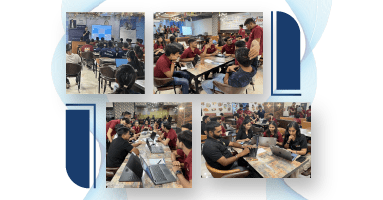
Across all 39 teams, including Cleerly, SolveCube, Uniquily, Boomcloud, Teladoc Core, BrickPrism, AI Mavericks, Team ENGAGE, VoXlearn, GreenMinds, FiboAI Innovation, ByteBrains, Tudip Titans, and more, the thread running through the day wasn’t AI for its own sake. It was, “Here’s something genuinely broken, and here’s how we’d go about fixing it.”
Teams submitted their ideas at 4:30 PM, though the conversations carried on well past that. The event closed with a session by Aniket Samarth on AI with Claude & Communication Fundamentals, which kept people engaged through to the end.
Participants signed up voluntarily. Manikarnika Ganpate, one of the attendees, described her reason for joining: “I joined to explore practical AI solutions, collaborate with colleagues, and learn through hands-on innovation. It was an exciting opportunity to turn ideas into something meaningful.”
Sovan Mishra, whose team focused on learning experiences, noted that the hackathon offered something beyond the event itself: “It gave us a platform to explore how products like VoXgent can identify learning gaps, confusing content, and unclear instructions, helping create value for both curriculum teams and learners.”
While the AI Hackathon lasted only a few hours, many of the ideas generated have the potential to influence future product development.
Not every idea from the day will become a product. Some will evolve, some will inform work already in progress, and some will sit with people until the right moment to pick them back up.
What the day produced most reliably was the kind of cross-team thinking that doesn’t usually happen during a normal sprint. People who don’t typically work together spent an afternoon on the same problem. That tends to lead somewhere useful, even if it takes a while to see where.
For Tudip, the AI Hackathon was one afternoon. The questions it raised will probably take longer to answer.
Find solutions to your queries.
Our clients rely on us to help them rethink how they work with technology.