


Predictive maintenance is a software solutions maintenance strategy that uses data analysis and machine learning in order to predict when equipment may fail. This means that maintenance can be planned, which also minimizes downtime and reduces maintenance costs. Within the realm of smart manufacturing, which is characterized by interconnected systems and real-time data, predictive maintenance proves to be a potent tool.
How Smart Manufacturing Works and the Role of Predictive Maintenance
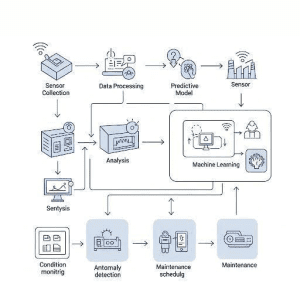
With the help of IoT sensors, cloud computing, and AI, smart manufacturing helps optimize the production processes. This approach maps very well with the concept of predictive maintenance and the oceans of data generated in smart factories. Here’s how it works:
Data Collection: Sensors installed in manufacturing equipment continuously collect data related to their different parameters like pressure, vibration, temperature, and electrical current generated by the machines.
Data Processing: The data is sent out to centralized systems (often in the cloud) where it’s processed and analyzed.
Predictive Modelling: Historical data and real-time sensor readings are used to build predictive models using machine learning algorithms. These models can detect patterns and anomalies that may signal impending equipment failures.
Maintenance Scheduling: As soon as the model indicates that a failure is on the way, maintenance can be scheduled proactively to avoid disruption in production.
Benefits of Predictive Maintenance in Smart Manufacturing
- Decrease in Downtime: The most obvious benefit of predictive maintenance is the minimization of unplanned downtime that comes from predicting and preventing impending failures. This means smoother production.
- Reduced Maintenance Costs: Maintenance is done only when required, removing unnecessary regular checks and lowering the overall cost of maintenance.
- Longevity of Equipment: Proactive maintenance helps to extend equipment life by fixing problems before they cause catastrophic damage.
- Enhanced Efficiency: With optimal maintenance schedules, resources can be allocated more effectively, thus improving operational efficiency.
- Improved Safety: Enhancing safety in a workplace through predictive maintenance by recognizing possible equipment failures.
Diagram of a Predictive Maintenance System
Conclusion
Predictive maintenance is a crucial component of smart manufacturing, offering significant advantages in terms of efficiency, cost savings, and safety. As manufacturing continues to evolve with the integration of advanced technologies, predictive maintenance will play an increasingly vital role in ensuring smooth and optimized production processes.