

Forbes India Leader Recognition
e.preventDefault(); // Prevent form submission input.blur(); // remove focus input.value = ""; // optional: clear the input

What is KMEANS Unsupervised Learning Algorithm?

What is KMEANS Unsupervised Learning Algorithm?

Featured Image

Before we deep dive into KMeans algorithm first we need to understand what clustering is. So,

What is Clustering?

  • Clustering is an unsupervised learning technique.
  • It is the task of grouping a set of objects in such a way that objects in the same group(cluster) are more similar to each other than to those in other groups.

Various algorithms are:

  • KMEANS clustering.
  • Hierarchical Clustering.
  • Density Based Spatial Clustering of Applications with Noise (DBSCAN).
  • Expectation – Maximization algorithm.

KMeans Clustering Algorithm

  • In KMEANS we try to group the people or group the observation based on the similarity and the similarity is measured using the distance and the distance used is Euclidean distance.
  • KMeans is a non-deterministic algorithm. Why non-deterministic? This is because our output is not fixed even when our input data is fixed and all the processing steps are fixed, our output may slightly change everytime we run our KMeans algorithm.
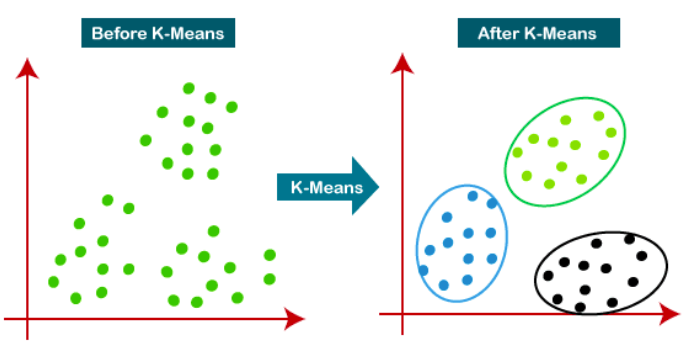
  • In KMEANS clustering, the given data points are grouped into K clusters, based on the similarity of the data points.

Now, there may be a doubt that how to select K in KMeans

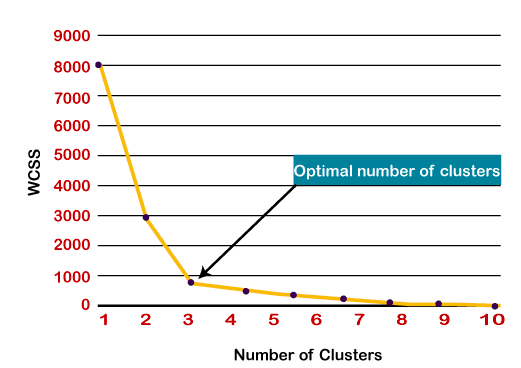
Elbow Method: In Elbow method or Elbow plot, on our x-axis we have number of clusters and on y-axis we have sum squared distance or also called sum squared error for each number of clusters and wherever we see a sudden drop we take that cluster as an optimum number of clusters.
What is KMEANS Unsupervised Learning Algorithm?

Here, from the above elbow plot figure, we can see that there is a sudden drop (bend) in 3. Hence our optimal number of clusters (K) will be 3.
What is KMEANS Unsupervised Learning Algorithm?

Algorithm:

Step 1: Randomly select k cluster centers vi…..vk.

Step 2: Calculate the distance between each data point aj and each cluster   centers vi

Step 3: Assign each data point aj to the cluster centre vi for which the distance

|| aj-vi|| is minimum.

Step 4: Recalculate each cluster center by taking the average of cluster’s data points.

Step 5: Repeat from step 2 to step 4 until the recalculated cluster centers are same as previous or no reassignment of data points happened

Distance between data points:

Let’s assume that each data point is a  n-dimensional vector.

The distance between two data points:

x=(x1…….xn)

and 

y=(y1............yn)

Is defined as

||x-y||=(x1-y1)2+.............(xn-yn)2

Related Posts

Latest Posts

  • All Posts
  • AI Powered Knowledge
  • ai/ml
  • CEO India Magazine
  • CMMI level 5 Certification
  • e-learning
  • Fintech
  • gaming
  • Generative AI
  • healthcare
  • manufacturing
  • News
  • OTT
  • Portfolio
  • supply chain
  • travel and hospitality
  • Tudip's AI Hackathon
  • Voxlearn Enterprises
    •   Back
    • Android
    • iOS
    • Java
    • PHP
    • MEAN
    • Ruby
    • DotNet
    • IoT
    • Cloud
    • Testing
    • Roku
    • CMS
    • Python
The Future of Workplace Learning: AI-Powered Knowledge on Demand

The Future of Workplace Learning: AI-Powered Knowledge on Demand

June 12, 2026

A few months ago, I was sitting in a meeting with a team lead who looked genuinely frustrated. Not because…

Read More
We Built VoXlearn Because Enterprise Training Was Broken: Here’s What We Did About It

We Built VoXlearn Because Enterprise Training Was Broken: Here’s What We Did About It

June 12, 2026

If you’ve ever sat through an end-of-quarter training report and thought, “We spent all that time and money, and this…

Read More
We Did It Again: Tudip Successfully Renews Its CMMI Level 5 Certification

We Did It Again: Tudip Successfully Renews Its CMMI Level 5 Certification

June 9, 2026

Nobody around here needed a memo to know something worth celebrating had happened. The message from the CMMI Institute said…

Read More

India

Plot No. 11/2, Phase 3, Hinjewadi Rajiv Gandhi Infotech Park, Pune, India – 411057.
info@tudip.com
+91-96-8990-0537

United States

1999 S. Bascom Ave Suite 700, Campbell CA. 95008, USA.
info@tudip.com
+1-408-216-8162

Canada

64 Caracas Road North York, Toronto Ontario M2K 1B1, Canada.
info@tudip.com

Mexico

Calle Amado Nervo #785 Interior B Colonia Ladron De Guevara 44600 Guadalajara, Jalisco, Mexico.
info@tudip.com

Singapore

77 High Street, #10-12B High Street Plaza, Singapore 179433.
info@tudip.com

Colombia

Cra. 9 # 113-53 Of. 1405 Bogotá D.C., Colombia.
info@tudip.com

UAE

Tudip Information Technologies L.L.C Office No 109, ABU HAIL BUILDING 13, Abu Hail, Dubai, UAE.
info@tudip.com

Nigeria

22 Kumasi Crescent, Wuse 2, Abuja, Nigeria.
info@tudip.com