



The Machine Can Predict. It Still Can’t Sit With You.
Inspired by the clinical integration strategies and cutting-edge solutions detailed in Artificial Intelligence in Healthcare by Dr. Parag Suresh Mahajan.
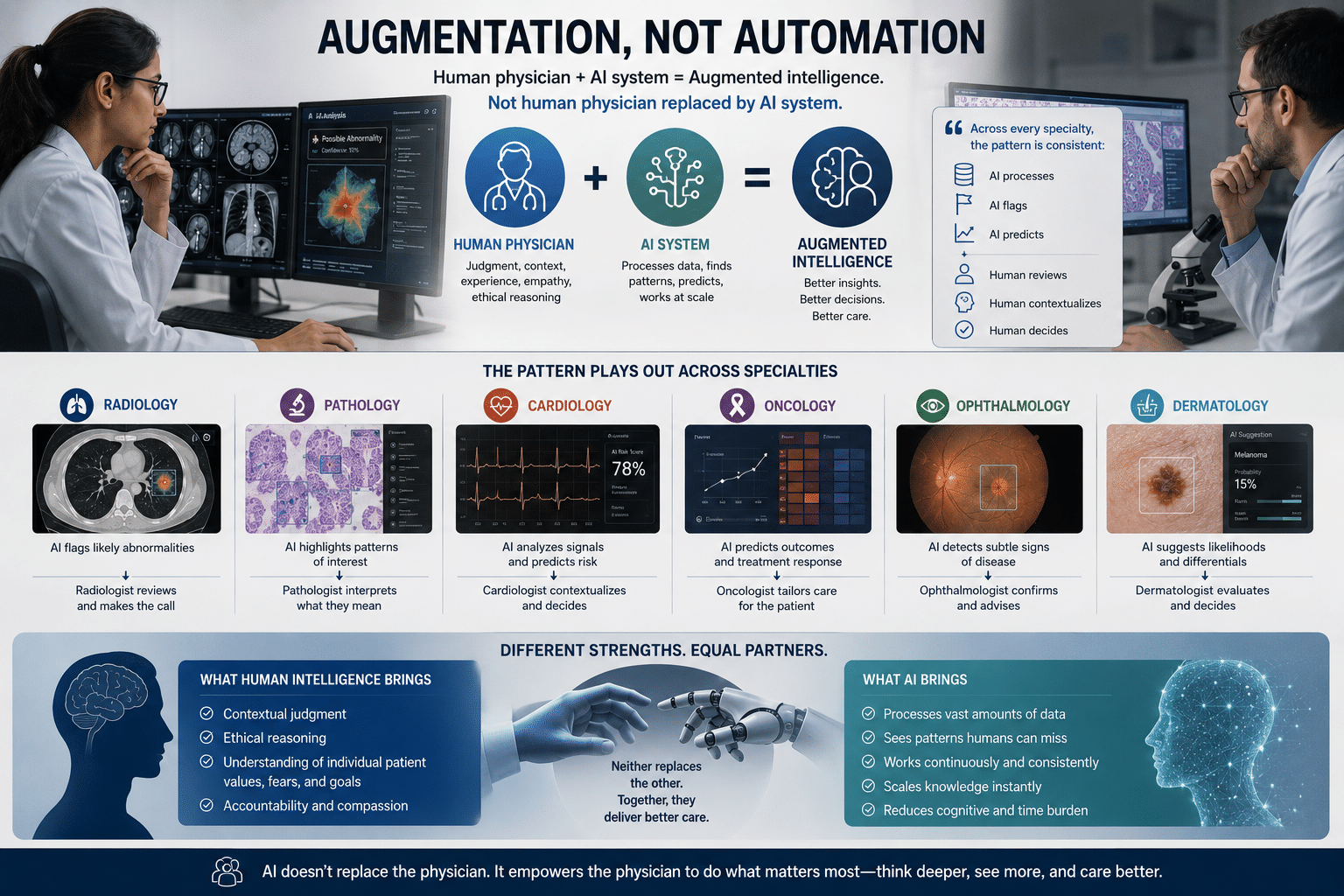
An AI model flags a patient as high-risk for a disease that hasn’t shown a single symptom yet. Technically, this is a triumph — pattern recognition catching something no human would have noticed at this stage. And then what? Someone still has to walk into that patient’s room, deliver the news, answer the question that always comes next — “what does this mean for me?” — and stay in the room while the patient absorbs it.
That gap, between what a machine can calculate and what a human still has to carry, sits at the center of Artificial Intelligence in Healthcare by Dr. Parag Suresh Mahajan, a physician’s attempt to map an entire field that keeps growing faster than anyone can fully document it — the book’s own page count nearly quadrupled between its first edition in 2018 and its most recent academic edition in 2022.
Neither a Warning Nor a Sales Pitch
Most conversations about AI in medicine collapse into one of two stories. Either doctors are about to be replaced by algorithms, or AI is a shortcut past medicine’s oldest problems — too few specialists, too much data, too little time. This book, written by a physician rather than a technologist, resists both stories.
Its opening move is to ask a different question entirely. Not “can AI diagnose patients instead of doctors?” but “how can AI help doctors make better decisions?” That’s a small rewording with large consequences. It shifts the whole conversation away from competition and toward collaboration — and once you notice that reframing, it’s genuinely hard to unsee it in how the rest of the book approaches everything from cancer screening to hospital scheduling.
The book’s real subject, then, isn’t AI’s capabilities in the abstract. It’s the much harder, much less flashy question of where those capabilities actually belong in a system built around human judgment, human accountability, and human patients — and where they don’t.
Augmentation, Not Automation
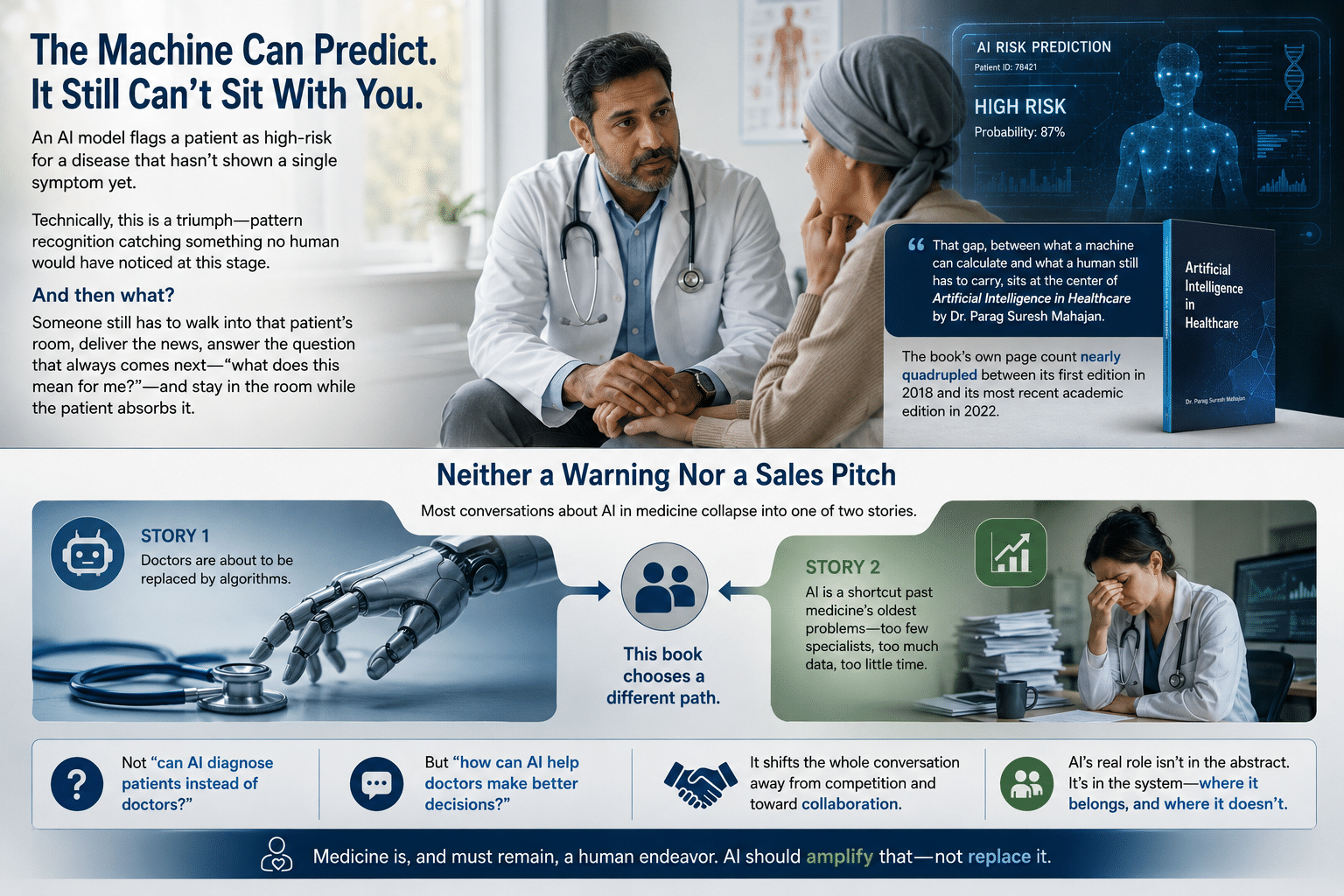
If there’s one idea this book keeps returning to, chapter after chapter, specialty after specialty, it’s this: human physician plus AI system equals augmented intelligence. Not human physician replaced by AI system.
It sounds almost too simple to be the load-bearing idea of a 600-page book. But watch how it plays out in practice, and the simplicity becomes the point. A radiologist reviewing thousands of scans doesn’t get replaced by an algorithm that flags likely abnormalities — the algorithm expands what the radiologist can efficiently notice, and the radiologist still makes the call. A pathologist examining digital tissue slides doesn’t hand over diagnosis to computer vision — the software highlights patterns worth a closer look, and human interpretation still decides what they mean. Across radiology, pathology, cardiology, oncology, ophthalmology, dermatology, the pattern repeats with almost stubborn consistency: AI processes, flags, and predicts. A human reviews, contextualizes, and decides.
What makes this more than a comforting slogan is how deliberately the book pairs it with the limits of what AI can actually offer. Human intelligence, in this framing, brings something AI structurally cannot — contextual judgment, ethical reasoning, an understanding of what a particular patient actually wants from their care. AI brings something equally real but categorically different — the ability to process volumes of data, and continuously, in ways no human clinician physically can. Neither one is positioned as the lesser partner. They’re just doing different jobs.
From Waiting for Symptoms to Watching for Signals
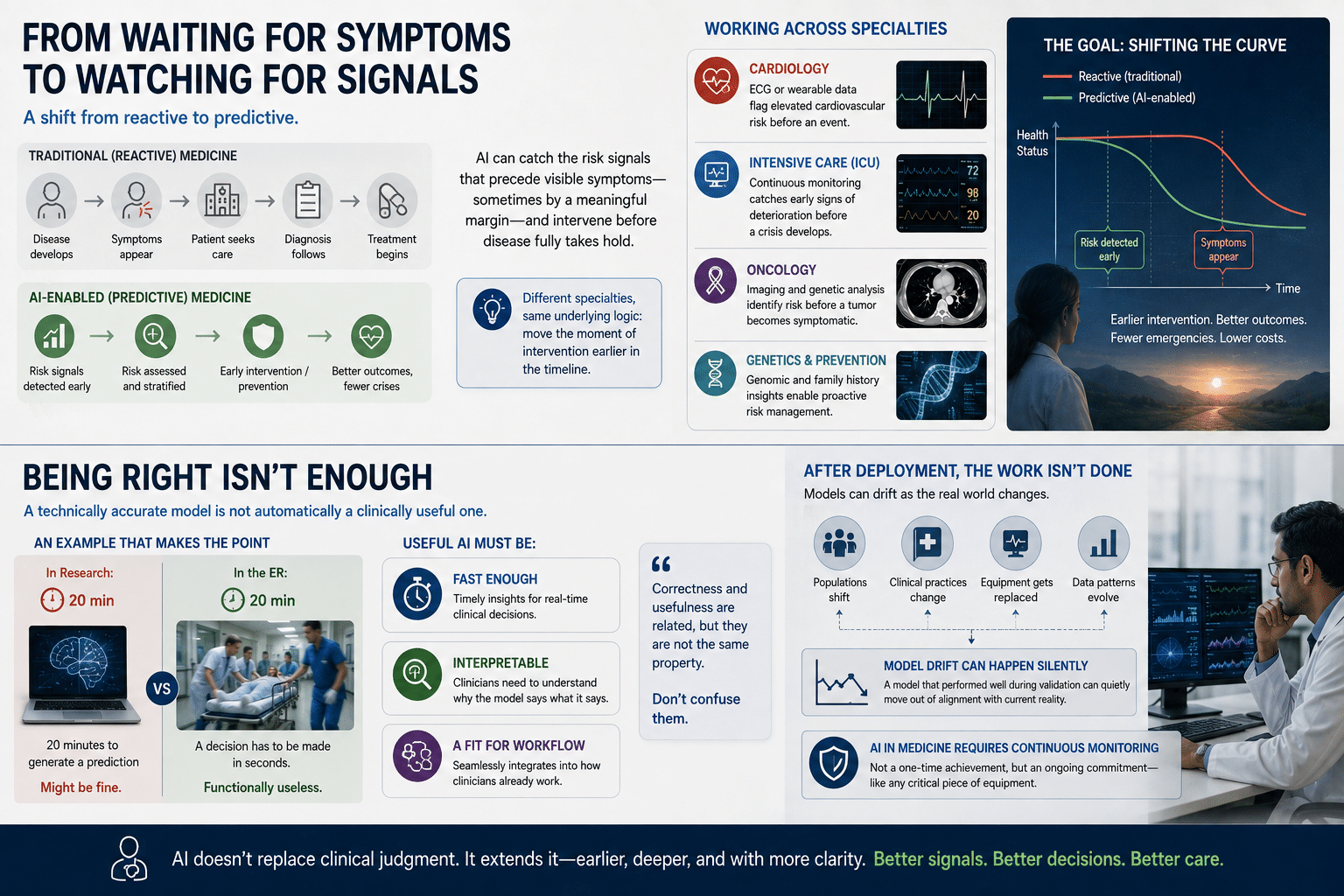
The second major idea worth sitting with is a genuine shift in the shape of medicine itself: from reactive to predictive.
Traditional medicine, as the book frames it, has always followed roughly the same sequence — disease develops, symptoms appear, a patient seeks care, a diagnosis follows, treatment begins. It’s a model built around responding to problems that have already become visible. AI opens a different possibility: catching the risk signals that precede visible symptoms, sometimes by a meaningful margin, and intervening before a disease has fully taken hold.
You can see this idea working across nearly every clinical chapter the book covers. In cardiology, patterns in ECG or wearable data flagging elevated cardiovascular risk before a cardiac event occurs. In the ICU, continuous monitoring of vital signs catching early signs of deterioration before a crisis develops. In oncology, imaging and genetic analysis identifying risk before a tumor becomes symptomatic. Different specialties, same underlying logic: move the moment of intervention earlier in the timeline.
It’s a genuinely exciting shift, and the book doesn’t undersell that excitement. But it also doesn’t let the excitement stand alone — which brings us to the part of the book that’s easy to skip past if you’re only looking for the impressive parts.
Being Right Isn’t Enough
Here’s where the book gets genuinely useful rather than just optimistic: it insists, repeatedly, that a technically accurate AI model is not automatically a clinically useful one.
There’s a specific example worth holding onto, because it makes an otherwise abstract point completely concrete: imagine an AI model that takes twenty minutes to generate a prediction. In a research setting, that might be perfectly fine. In an emergency room, where a decision has to be made in seconds, that same model — however accurate — is functionally useless. Speed, interpretability, and fit with how clinicians actually work turn out to matter just as much as raw predictive power.
This distinction generalizes further than medicine, if you let it. Plenty of things that are technically correct fail anyway because they don’t arrive in a form anyone can actually use in the moment they’re needed. A brilliant piece of advice delivered after the decision’s already been made. A perfectly accurate report nobody has time to read before the meeting starts. Correctness and usefulness are related, but they are not the same property, and confusing them is a mistake that shows up far outside hospital walls.
The book pushes this even further with its discussion of what happens after a model gets deployed. Healthcare populations shift. Clinical practices change. Equipment gets replaced. A model that performed well when it was validated can quietly drift out of alignment with the reality it’s now operating in — which means, in the book’s framing, that AI in medicine isn’t a one-time achievement to certify and forget. It’s something that has to be watched, the way you’d monitor any piece of equipment that could degrade silently over time.
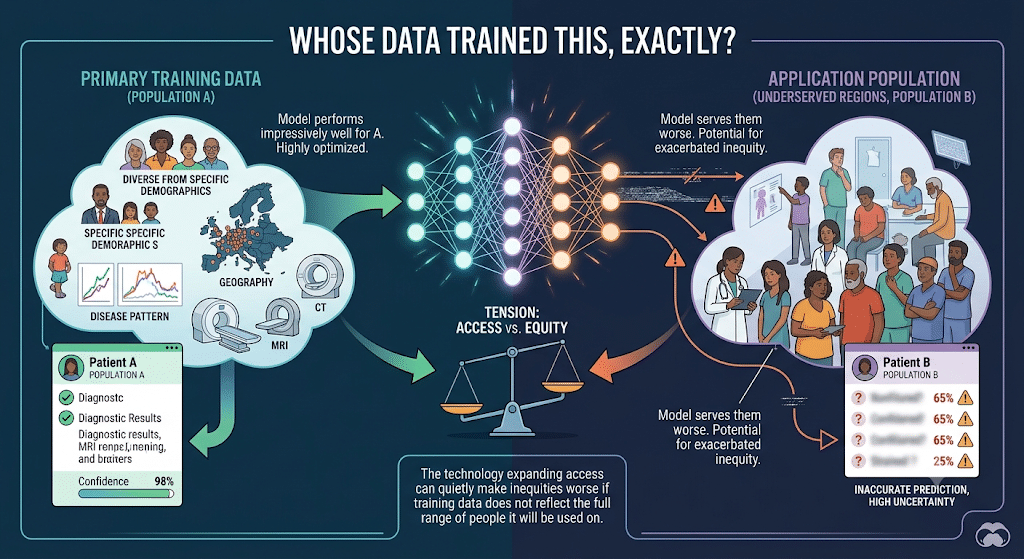
Whose Data Trained This, Exactly?
There’s a third idea in the book that’s less comfortable to sit with, and it deserves real attention: the same technology capable of expanding healthcare access to underserved regions is just as capable of quietly making existing inequities worse.
The mechanism is straightforward once it’s named. A model trained mostly on one population — shaped by that group’s demographics, geography, disease patterns, even the specific imaging equipment commonly used where the data was collected — can perform impressively well for that group and meaningfully worse for another. Nobody designed that outcome on purpose. It emerges naturally whenever training data doesn’t reflect the full range of people the system will eventually be used on.
What makes this genuinely thought-provoking rather than just a technical caveat is the tension it creates with the book’s own optimism about access. AI-assisted screening could bring specialist-level pattern recognition to primary care centers in areas with few specialists available — a real, meaningful benefit for people who currently have limited access to expert care. But if the underlying model wasn’t built and validated on data representative of those exact populations, the same tool meant to expand access could end up serving them worse than it serves the population it was originally trained on. The book doesn’t resolve this tension with a tidy answer. It holds both truths at once, which is a more honest position than most conversations about AI and healthcare equity manage to take.

The Room the Algorithm Can’t Enter
Which brings us back to where we started. Running underneath every technical chapter in this book is a quieter, more human thread — the insistence that healthcare has never been purely a matter of processing information correctly.
The book is direct about this in its discussion of mental health specifically, where it notes that AI can analyze notes, questionnaires, speech, and behavioral patterns — but that mental health, more than almost any other specialty, depends on human relationship, context, and trust in ways that shouldn’t be engineered around. But the same idea threads through the rest of the book too, in its consistent framing of physicians retaining not just clinical judgment but also communication, empathy, and care coordination as AI absorbs more of the routine information-processing work.
There’s something worth carrying from this beyond medicine. Prediction and diagnosis are things a system can, in principle, get very good at. Sitting with someone while they process difficult news is not the same kind of task, and no amount of processing power changes that. The book seems to understand this distinction clearly enough to build its entire structure around protecting it.
What Actually Stays With You
A handful of ideas from this book are worth carrying past the last chapter.
The augmentation framing — human plus AI, not human replaced by AI — is a genuinely useful lens for evaluating almost any AI tool being introduced into a serious profession, not just medicine. It gives you a real question to ask: is this expanding what a skilled person can see and do, or is it quietly asking to take over their judgment?
The accuracy-versus-usefulness distinction, crystallized by that twenty-minute prediction, is worth applying well outside hospitals. Being right is necessary. It has never been sufficient on its own.
And the tension between AI’s potential to expand access and its potential to encode existing inequity is worth sitting with rather than resolving too quickly. The technology itself doesn’t decide which direction it goes. The data it’s built on, and the care taken in validating it, do.
One Last Question
Somewhere in this book is a fact worth remembering the next time a headline promises that AI is about to transform healthcare: the technology has always been capable of the exciting part. Detecting a pattern early, flagging a risk before it becomes a crisis — none of that is really the hard part anymore.
The harder question, the one the book keeps circling back to without ever fully closing, is who gets to be seen clearly by these systems, and who gets left slightly out of focus. That’s not a question a model answers on its own. It’s a question about who builds it, whose data it learns from, and who’s still in the room, paying attention, when the prediction turns out to be wrong.
Read It. Explore It. Apply It.
Loved the ideas in this book?
There’s more to discover.
Testily.AI is trained on the principles and insights explored in books like this—helping you go beyond reading and explore how these ideas can apply to your own journey.
Continue exploring with Testily.AI
And if you’re hungry for more, discover our other book insights and articles.
Email us at info@tudip.com to enhance patient care today.