




Machine 17 Has a Problem, and It’s Telling You Before It Breaks
Inspired by the insights on artificial intelligence and technology awareness presented in (AI Awareness Series Book 11) by Robert Thornfield-Wells.
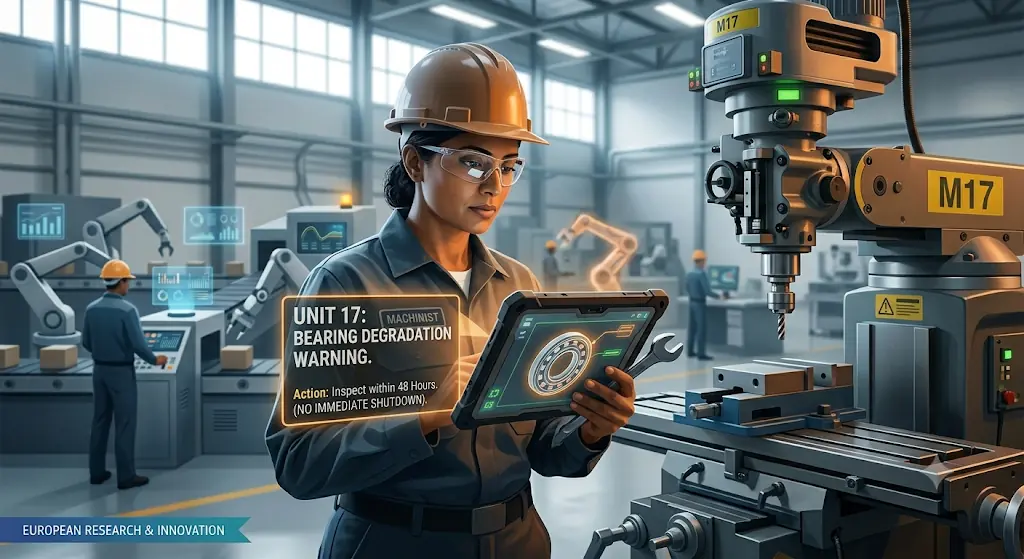
Picture an alert on a maintenance engineer’s screen: Machine 17 — high probability of bearing degradation — inspect within 48 hours. No siren. No shutdown. Just a quiet, specific warning, days ahead of a failure that hasn’t happened yet.
That single alert captures something most conversations about AI in factories miss entirely. It isn’t about robots replacing people or algorithms running the plant unsupervised. It’s about a machine telling a human where to look first — and the human still deciding what to do about it.
That small scene sits at the heart of AI in Manufacturing, a practical guide aimed less at engineers who want to understand neural networks and more at the people who actually run factories and have to decide where, if anywhere, AI adoption is worth the money. The book’s stated goal is refreshingly narrow: separate AI hype from what’s actually producing measurable results on production floors today. Not “AI will change everything eventually” — but “here’s what it’s already doing, and here’s what it takes to make that work.”
The Question That Comes Before the Technology
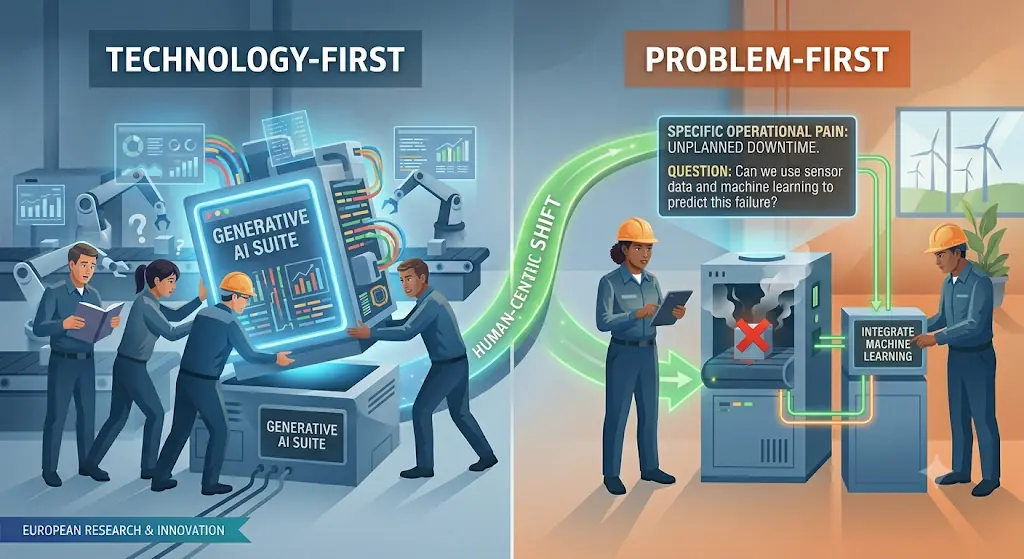
There’s a line of reasoning running through the book that’s easy to state and surprisingly hard to follow in practice: start with the problem, not the tool.
The contrast the book draws is blunt. A weak AI strategy sounds like “we need to implement generative AI because AI is important.” A strong one sounds like “our factory loses significant production time because equipment failures are unpredictable — can we use sensor data and machine learning to predict those failures?”
Read those two sentences back to back and the difference is obvious. But it’s worth sitting with why so many organizations still start with the first one. Adopting a trendy technology feels like progress. Naming a specific, unglamorous operational pain point — unplanned downtime, a recurring defect nobody’s traced to its source, inventory that’s always slightly wrong — feels less exciting, and more exposing. It means admitting a concrete problem exists before you get to talk about the exciting solution.
The book’s implicit bet is that this order matters more than almost anything else in determining whether an AI investment actually pays off. Get the sequence backwards — technology first, problem later — and you end up with expensive software nobody quite knows what to do with.
Three Ways to Think About a Machine That Might Fail
If there’s one idea in this book built to stick with a reader, it’s the reframing of maintenance into three distinct philosophies, because it quietly overturns something most people assume is already solved.
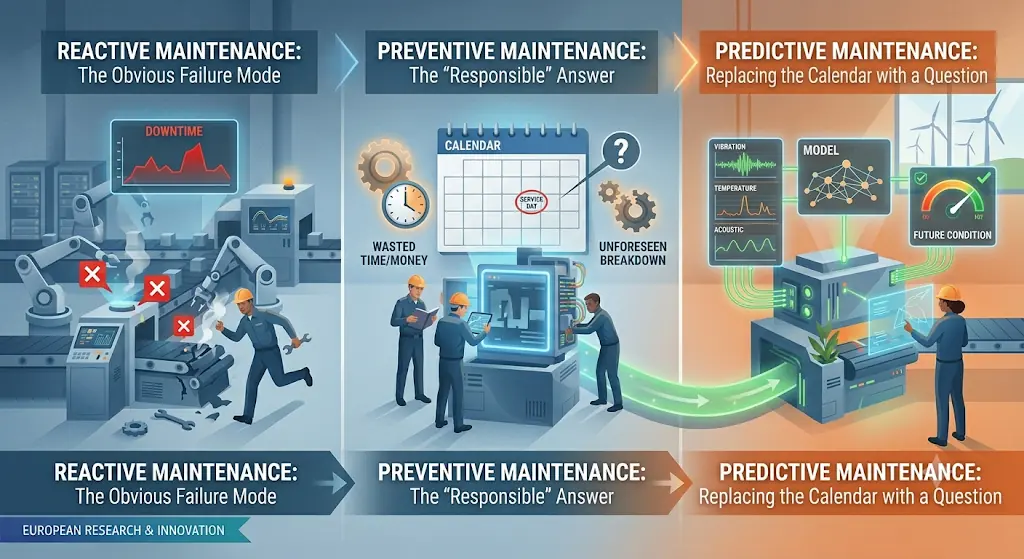
Reactive maintenance is the obvious failure mode: something breaks, then you fix it. Nobody defends this as a strategy; it’s what happens by default when there’s no strategy at all.
Preventive maintenance is the “responsible” answer most of us assume is good enough — service the machine on a fixed schedule, say every 10,000 operating hours. It sounds disciplined. It sounds like the mature version of maintenance. Here’s the part that’s genuinely counterintuitive: the book points out that this approach fails in both directions. The part might still be perfectly healthy when it gets serviced, wasting money and time on unnecessary work. Or it might fail before the schedule catches up to it, which defeats the entire purpose of having a schedule.
Predictive maintenance replaces the calendar with a question. Instead of asking “when should we service this machine?” it asks “what does this machine’s current behavior tell us about its future condition?” Sensors track vibration, temperature, pressure, acoustic signals, motor current — and machine-learning models look for patterns that tend to precede failure, flagging risk before it becomes a shutdown.
What makes this section more than a technical footnote is how neatly it maps onto a much broader pattern in how people handle risk generally. Most of us live somewhere between reactive and preventive in our own lives — fixing things once they break, or maintaining things on a rough, arbitrary schedule that has more to do with habit than actual need. The idea of shifting from “when should I check on this” to “what is this telling me right now” is a small mental move with a much wider reach than factory equipment.
Catching What the Human Eye Misses, Without Losing the Point of Inspection
The book’s treatment of AI-based quality control follows a similar shape to the maintenance discussion: it starts where you’d expect, and then goes somewhere more interesting.
The obvious pitch is speed and consistency — a camera and a model can inspect products at production-line speed, catching scratches, cracks, dimensional errors, missing components, contamination, far faster than a human ever could. That’s the part most people already assume AI does well.
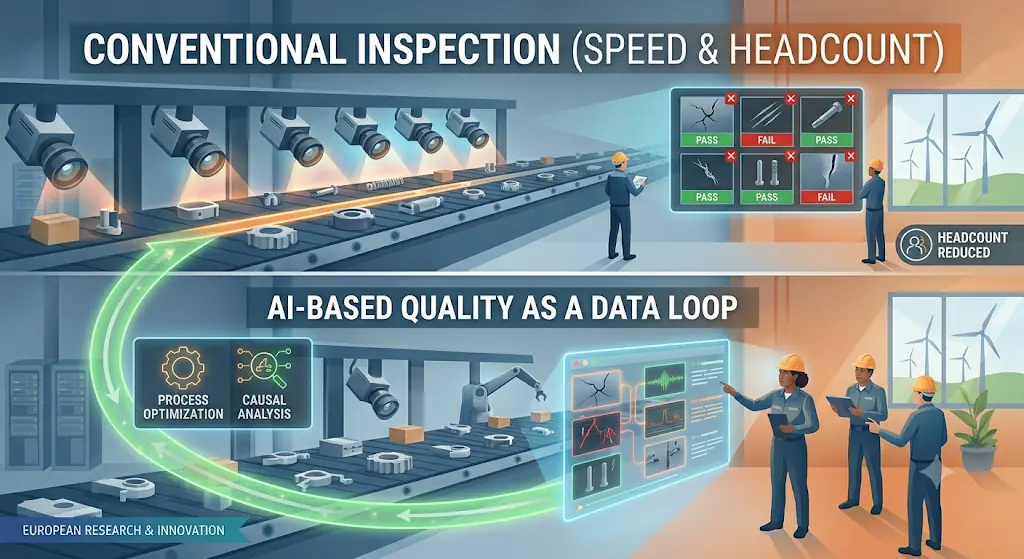
The more useful idea buried underneath is that this isn’t really about replacing inspectors. It’s about generating a new kind of data. Every defect an AI system flags becomes a data point that can be traced back toward a cause. Recurring patterns become visible in a way they weren’t before, because nobody was systematically tracking them at that resolution. Quality inspection stops being a checkpoint at the end of the line and starts becoming an input into a larger, ongoing improvement loop.
This matters because it reframes what “success” looks like. A factory that adopts AI quality control purely to cut inspection headcount is optimizing for the wrong thing. A factory that adopts it to understand why defects keep happening in the first place is using the same technology to solve a deeper problem.
The Unglamorous Truth Underneath Every Application
Here’s where the book earns some credibility rather than just enthusiasm: it’s willing to say, more than once, that none of this works without something far less exciting than AI — good data.
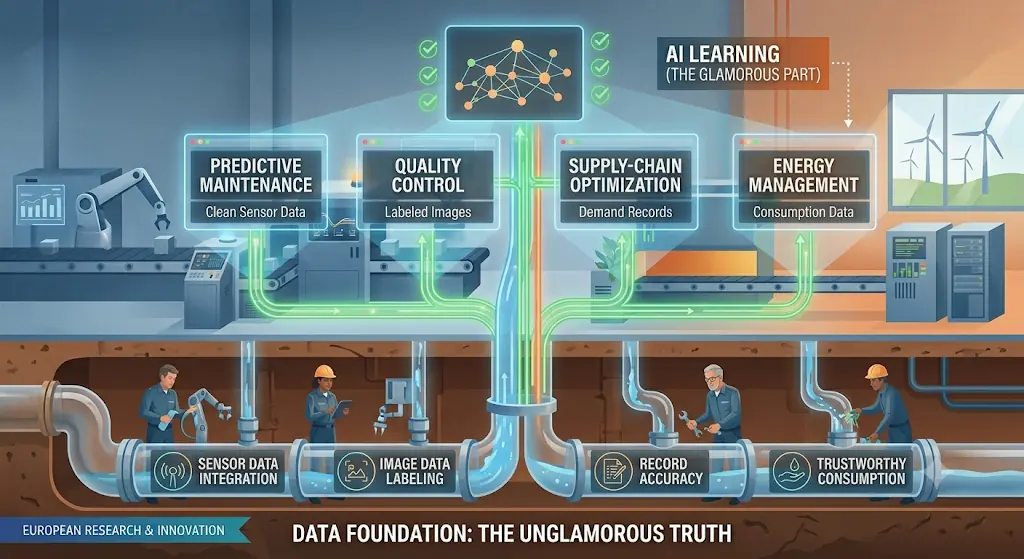
The phrase used is direct: AI transformation is fundamentally also a data transformation. A factory can have the most sophisticated predictive model available and still get nothing useful out of it if the underlying data is inconsistent, incomplete, or poorly integrated. This is the part of the story that doesn’t make it into most AI marketing, because it’s not a feature anyone’s selling. It’s plumbing.
This idea connects everything else in the book. Predictive maintenance depends on clean sensor data. Quality control depends on well-labeled image data. Supply-chain optimization depends on accurate historical demand and supplier records. Energy management depends on consumption data that’s actually trustworthy. Strip away any one of these applications and you find the same dependency sitting underneath: collect data, make sure it’s good, and only then start asking a model to find patterns in it.
It’s a quietly deflating point, in the best sense. It suggests that a lot of the real work in “AI adoption” isn’t glamorous model-building at all — it’s the much less exciting discipline of getting your data infrastructure into a state where a model would even have something useful to learn from.
A Machine’s Mistake Isn’t Just a Bad Spreadsheet
The book draws one more distinction worth pulling out on its own, because it explains why manufacturing AI carries different stakes than most of the AI conversations people are used to having.
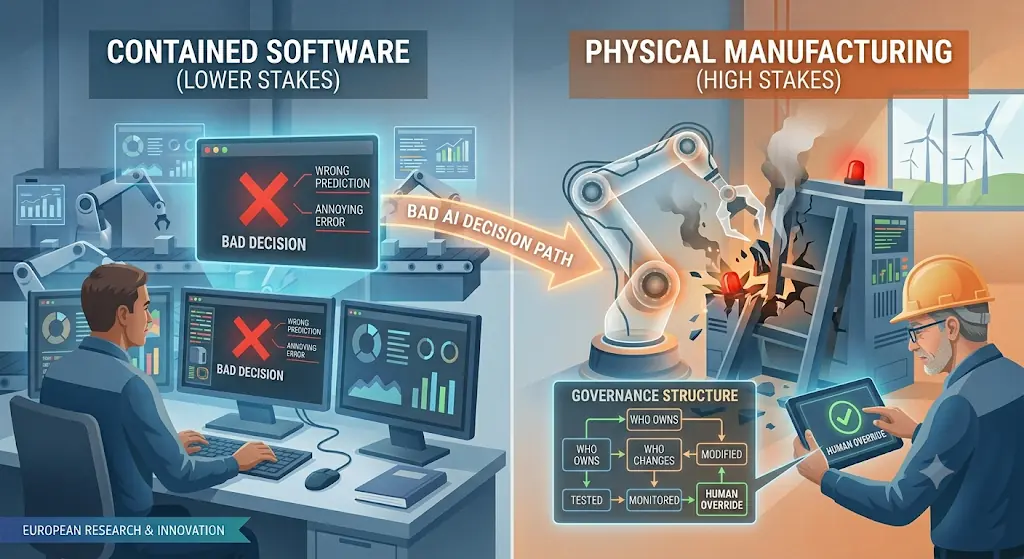
In a lot of software contexts, a bad AI decision means an incorrect recommendation, a wrong prediction, an annoying error — something contained to a screen. In manufacturing, the book points out, a bad AI decision that influences machine settings, production schedules, or robotic movement can mean defective products, damaged equipment, safety incidents, or real downtime. The consequence lives in the physical world, not just in a dashboard.
That’s why the book treats governance — who owns an AI system, who can change it, how it gets tested, how a human can override it, how it’s monitored over time — as a genuine requirement rather than a compliance afterthought. It’s a natural extension of the human-in-the-loop idea from the Machine 17 example: if a person is meant to stay in the decision loop, there has to be a real, working structure that makes that possible, not just a vague assumption that “someone” will catch mistakes.
Where the Optimism Gets a Reality Check
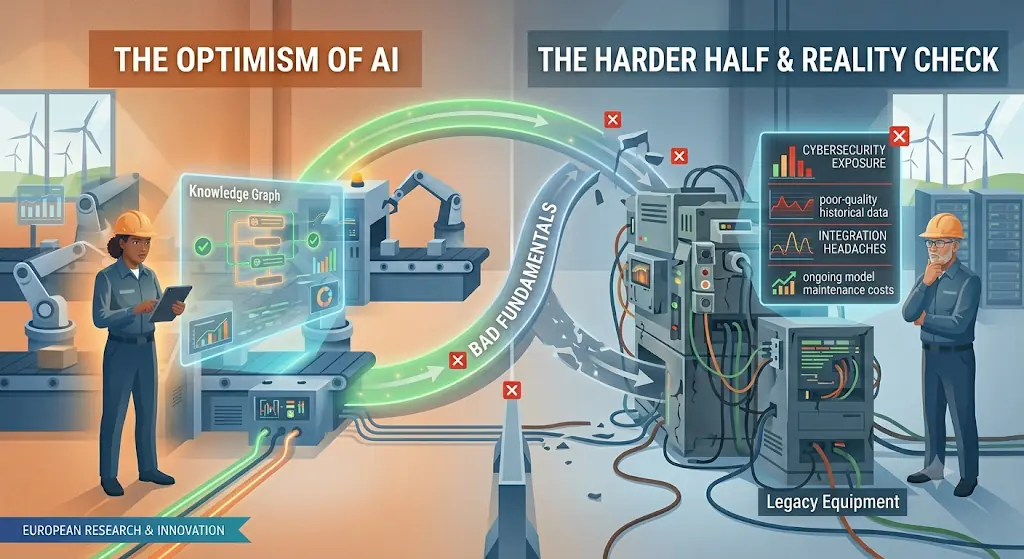
To its credit, the book doesn’t pretend all of this is simple or guaranteed. It’s upfront that AI adoption in manufacturing runs into real obstacles: legacy equipment that wasn’t built with sensors in mind, poor-quality historical data, integration headaches with existing systems, cybersecurity exposure, employee skepticism, ongoing model maintenance costs, and the sheer expense of doing any of this properly.
That creates a genuine tension the book doesn’t try to smooth over: AI can deliver real, measurable value, and most factories aren’t actually positioned to capture much of it yet. Those two things are both true at once. It would have been easy to write a book that only tells the optimistic half of that story. This one, at least based on what’s summarized here, seems to want credit for saying the harder half too — that AI amplifies operational discipline where it already exists, and exposes its absence where it doesn’t. It doesn’t function as a shortcut around bad fundamentals; if anything, it makes those weaknesses harder to ignore.
What Actually Carries Over
A few ideas from this material are worth holding onto well past a first read.
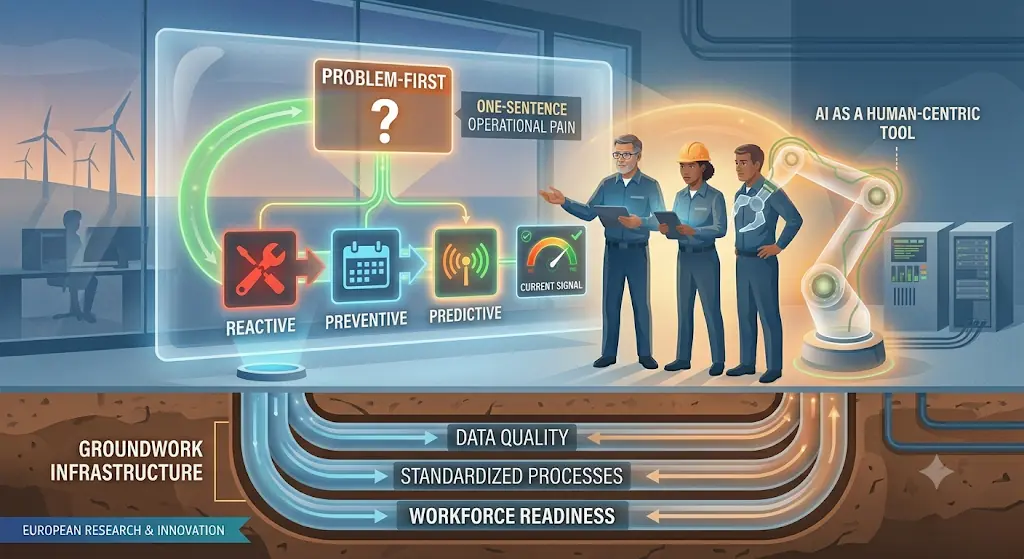
Naming the specific business problem before naming the technology isn’t a nice-to-have step — it appears to be the difference between an investment that pays off and one that doesn’t. If you can’t state the operational pain in one sentence, you’re probably not ready to talk about the solution yet.
The reactive-preventive-predictive framework is a genuinely portable way to think about risk, well outside of factory equipment. It’s worth asking, in almost any context involving upkeep or attention, whether you’re operating on a fixed schedule out of habit, or actually paying attention to what the current signals are telling you.
And the reminder that “AI transformation is also a data transformation” is a useful corrective any time a technology conversation starts moving faster than the groundwork underneath it. The unglamorous parts — data quality, standardized processes, workforce readiness — aren’t obstacles standing between an organization and its AI ambitions. They’re the actual substance of the work.
The Real Question the Book Leaves You With
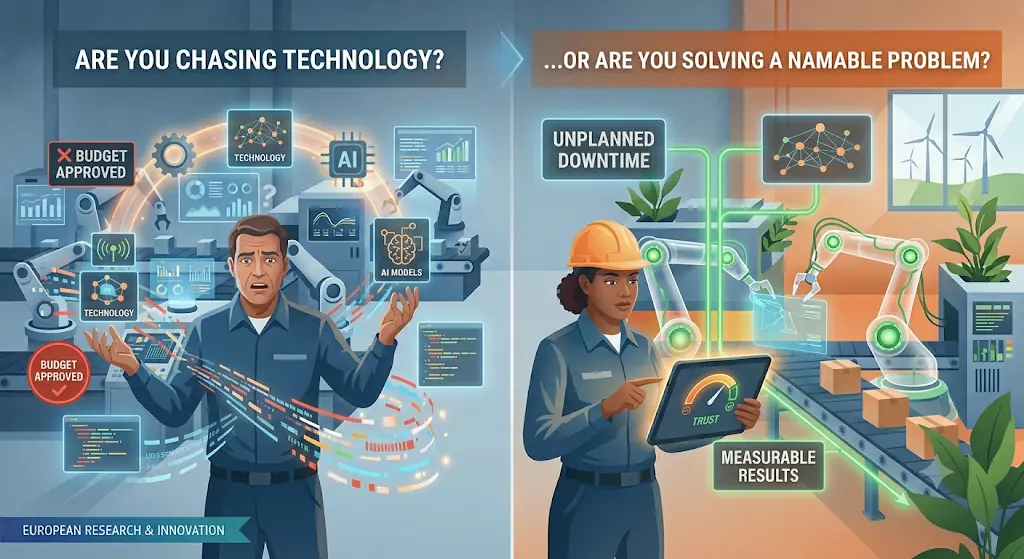
Strip away the specific applications — the sensors, the cameras, the models — and what’s left is a much simpler question, one that has nothing to do with manufacturing specifically: are you solving a problem you can actually name, or are you chasing a technology because everyone around you seems to be?
That question doesn’t stay confined to factory floors. It’s worth asking of your own next tool, your own next system, your own next “we should probably start using AI for this” conversation — before the budget gets approved, not after.
Read It. Explore It. Apply It.
Loved the ideas in this book?
There’s more to discover.
Testily.AI is trained on the principles and insights explored in books like this—helping you go beyond reading and explore how these ideas can apply to your own journey.
Continue exploring with Testily.AI
And if you’re hungry for more, discover our other book insights and articles.